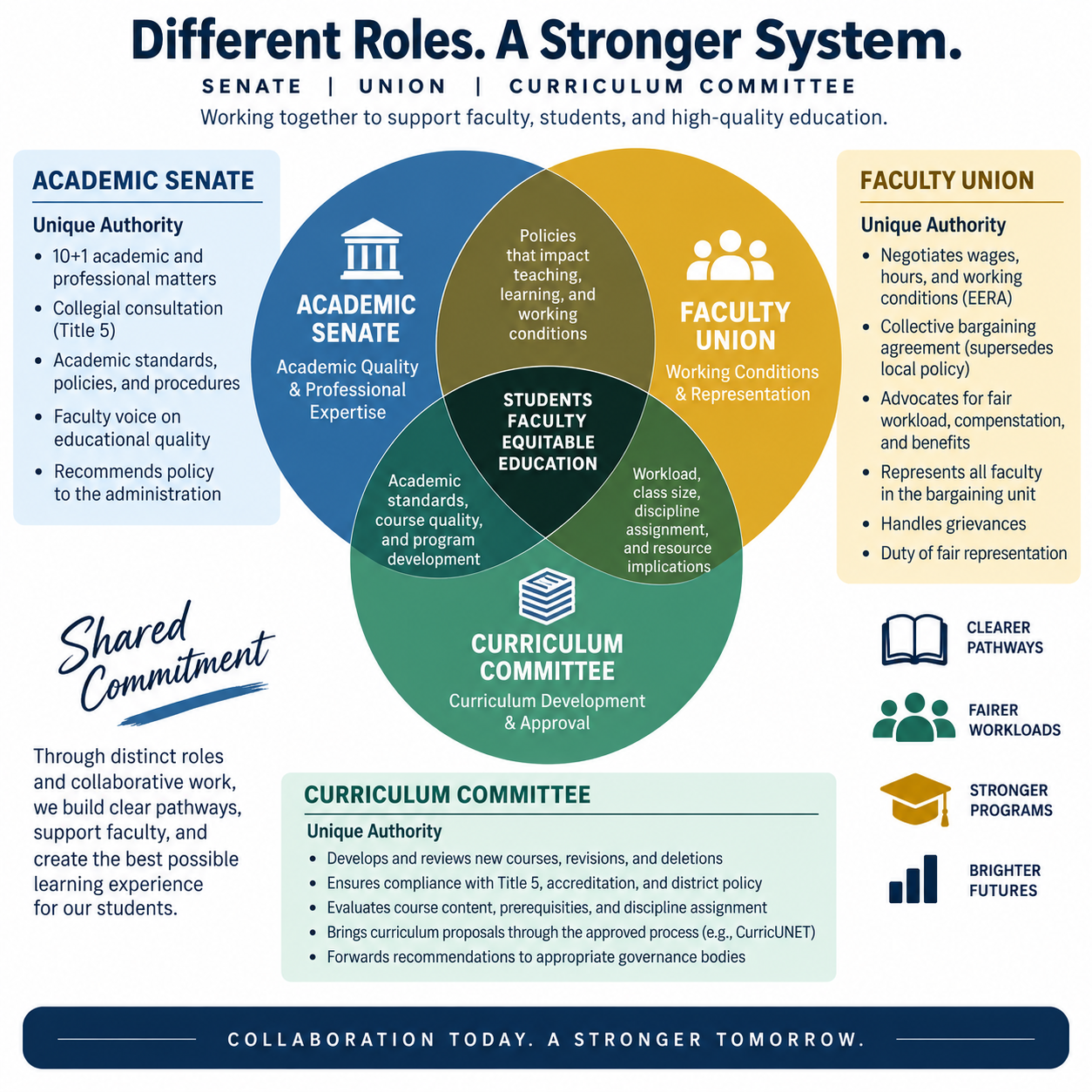
 Faculty governance in the North Orange County Community College District runs on three distinct-but-overlapping tracks. Understanding what each body does — and where they meet — is how members navigate their own questions to the right forum, and how the chapter as a whole protects faculty voice across every kind of decision that affects our work.
The three tracks
United Faculty (UF) is the exclusive bargaining representative for full-time faculty in the District. Our authority derives from the Educational Employment Relations Act (EERA, California Government Code § 3540 et seq.) and is realized through the Collective Bargaining Agreement (CBA) we negotiate with the District. EERA sets the scope of bargaining: wages, hours, and other terms and conditions of employment — including leaves, evaluations, workload, and grievance procedures. Where the CBA governs, it is enforceable through the grievance process and it supersedes local policy. UF also carries a duty of fair representation: we represent every full-time faculty member in the bargaining unit, whether or not they are UF members.
The Academic Senates — the Cypress College Academic Senate, the Fullerton College Faculty Senate, and the North Orange Continuing Education Academic Senate — represent faculty on academic and professional matters. Their authority derives from Title 5 of the California Code of Regulations, which lists eleven areas known as the "10+1" where the District must "consult collegially" with the Senate. Those areas include curriculum, degree and certificate requirements, grading policy, educational program development, standards of student preparation and success, district and college governance structures as related to faculty roles, faculty professional development activities, program review, institutional planning and budget development, processes for accreditation, and other academic and professional matters as mutually agreed upon.
Campus curriculum committees — and, at the district level, the District Curriculum Coordinating Committee (DCCC) — are where specific courses and programs are proposed, revised, and approved. They operate under both college processes and Administrative Procedure 4020. Faculty membership and faculty leadership of these committees is part of what makes shared governance real; curriculum is the day-to-day expression of the "10+1" academic and professional matters that Senates represent.
Where the tracks meet — and how they coordinate
Some decisions touch more than one track at once. Faculty evaluation procedures involve both union scope (they affect terms and conditions of employment) and Senate purview (they involve academic judgment). The academic calendar is a mandatory bargaining subject under EERA and also affects the academic and professional matters Senates represent. Faculty hiring procedures, professional development, program viability, reassigned time, tenure review processes, and textbook policies all touch both bargaining scope and Senate purview.
The Joint Collaborative Consultation Understanding (JCCU) is the framework the five NOCCCD faculty governance bodies — the three Academic Senates plus United Faculty and Adjunct Faculty United — have developed to coordinate across these overlaps. The current draft (dated 3.7.26) is available in the members-only Documents Library. Concrete commitments in the current draft include: monthly meetings of the five Presidents, semester joint meetings of the Executive Boards, and coordinated appointments to district-level committees, including district management hiring committees. The JCCU is reviewed annually at the start of fall semester and amendments require support across all five bodies.
The JCCU does not replace bargaining or the bylaws. It organizes how five separately-governed bodies coordinate where their work overlaps.
How to bring your question to the right place
When a faculty question involves your workload, compensation, contract rights, leaves, evaluations, or a possible contract violation, the right first contact is your Rep Council member or your campus Grievance Rep. That is bargaining and enforcement territory — the CBA governs.
When a question involves an academic or professional matter — curriculum content, program development, standards of student preparation, faculty roles in college and district governance processes — the right first contact is your campus Academic Senate. Senate leadership can agendize the item, bring it into the collegial consultation process, and coordinate with the other Senates and with UF as needed.
When a question touches both tracks — which happens frequently — contact your Rep Council member first. They can route the question, loop in Senate leadership through the JCCU coordination mechanism, and make sure the item lands in the right forum without falling between the seams.
Have a question or concern? Bring it through your Rep Council member — that is the formal channel for accurate, timely response. See Leadership & Reps for your campus and division contacts. Official UF updates are distributed only by email from UF role-based accounts and posted to UnitedFacultyNOCCCD.org.